
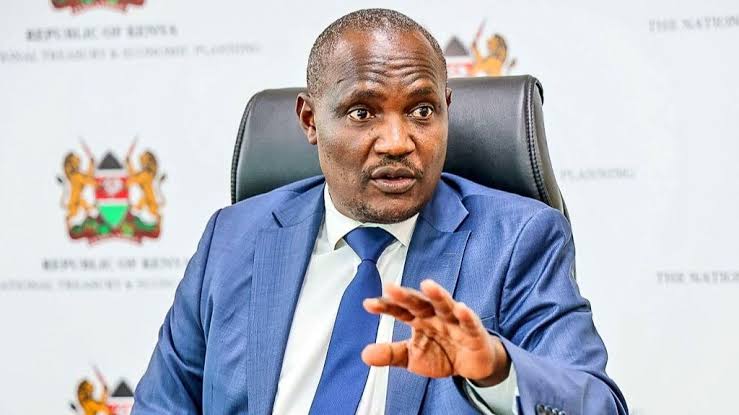
Treasury Cabinet Secretary John Mbadi has dismissed claims of a direct connection between the Nairobi Expressway and the Rironi-Mau Summit highway project, saying the two are separate Public-Private Partnership (PPP) ventures with different designs, investors and contractual arrangements.
Mbadi said although China Road and Bridge Corporation (CRBC), the contractor behind the Nairobi Expressway, is also involved in the Rironi-Mau Summit project, its role in the latter is different.
Speaking during an interview with a local station on Tuesday, November 17, 2026, the CS explained that CRBC is coming into the Rironi-Mau Summit project not only as a contractor but also as an investor, alongside other partners, including the National Social Security Fund (NSSF).
“I don’t think there is any link between the two. In my view, these are two separate projects that were done,” Mbadi said.
He noted that the initial design and contracting arrangements for the Rironi-Mau Summit highway involved a different contractor before the current arrangement was adopted.
“Today, what we have with Rironi-Mau Summit is we have CRBC, which is the contractor which did the Expressway. But now, CRBC is coming in as an investor as well, but in partnership with other investors including NSSF,” he explained.

According to Mbadi, the two projects have different designs, proposals and planning frameworks, making it inappropriate to treat them as connected ventures.
Mbadi responds to Nairobi Expressway financial concerns
The Treasury CS also addressed concerns surrounding the financial performance of the Nairobi Expressway, following questions about rising operational costs and whether the project had reached its expected break-even point.
He said he had not yet examined the project’s financial statements, contractual terms and original design to establish when investors were expected to recover their investment.
The discussion highlighted figures showing that the expressway’s revenue increased from Ksh7.1 billion in 2024 to Ksh9.6 billion in 2025.

Mbadi said the rising costs required closer scrutiny, noting that increased expenditure, rather than declining revenue, appeared to be the main factor behind the financial concerns.
He suggested that the increase could be linked to temporary economic shocks, global supply chain disruptions or other operational factors, although he cautioned against drawing conclusions without examining the details.
“Financial statements don’t mean much unless now you go deeper to understand why are the direct costs rising,” he said.
The CS added that the government would need to establish whether the rising costs were temporary or reflected weaknesses in the original project costing and implementation.
He acknowledged that if the initial costing was inappropriate, questions could arise over the work done by those involved in designing and implementing the project.
Treasury maintains Expressway poses no direct budget risk
Despite the concerns over rising costs, Mbadi maintained that the Nairobi Expressway was structured as a PPP project and therefore did not expose the national budget to direct financial risk.
He said the project was largely executed by Moja Expressway under the PPP arrangement, meaning the financial obligations associated with the investment were not directly borne by the government.
“There is no risk at all to our budget in terms of financial risk,” he said.

However, he maintained that he would need to review the agreement to understand the investment recovery period, the project’s expected break-even point and the factors contributing to the rising costs.
His remarks come amid broader public scrutiny of major infrastructure projects being undertaken through PPP arrangements, particularly their financial sustainability, investment recovery models and implications for taxpayers.